The Best Anti Fog Bathroom Mirrors (2026)
Prices and picks verified as of September 2026. Independent, reader-supported reviews.


Things to Know Before You Buy
- Two very different products share the same name. A small fogless shaving mirror (under $30) suction-mounts inside the shower stall. A full wall mirror with anti-fog pad ($50+) replaces your existing bathroom mirror and warms the glass with a built-in heating pad. Pick the category before you pick the model.
- Most small "fogless" mirrors rely on warm water, not coatings. You rinse the back with hot tap water before your shower; the warmth keeps the glass surface above the dew point for about 8–12 minutes. Spray-on coatings exist but wear off in weeks.
- Wall-mirror defoggers draw very little power. The heating pad sits behind a small section of the glass and runs on a low-wattage element — typically 25–40 W. Leaving it on during a 15-minute shower costs less than a penny.
- Suction quality is the #1 reason small mirrors fail. Cheap suction cups slide down within a week. Look for at least a 3-inch diameter cup or a locking lever mechanism; tile texture matters more than price.
- Distortion at close range is real on cheap models. A flat, properly-backed mirror will show no wave when you tilt it. Avoid models that wobble or look like they were trimmed from a sheet — they distort the very face you're trying to shave.
You step out of the shower, grab a razor, look up at the mirror — and see nothing but a milky fog. By the time it clears, you have already lost two minutes, the steam has cooled, and the bathroom is dripping. An anti-fog bathroom mirror solves this in one of two ways: either a small fogless mirror that suction-mounts inside the shower stall for shaving, or a full wall mirror with a built-in defogger pad that warms the glass enough to keep your reflection clear while you brush, dry your hair, or do your skincare routine.
We spent six weeks testing seven of the most popular anti-fog mirrors on Amazon — a mix of small fogless shower mirrors under $35 and full-size LED wall mirrors with integrated defoggers. We installed each one in a real bathroom (no test lab), checked how long it stayed clear after a ten-minute hot shower, how stable the suction or wall mounts felt over two weeks of daily use, and how distortion-free the reflection was at close shaving distance. We also looked at price, included accessories, and how the mirror behaves once the bathroom cools.
For most people, the HONEYBULL Fogless Shower Mirror with Suction Mount & Swivel ($16.99) is the right pick — it grips every tile surface we tried, swivels for shaving, and ships with a razor hook and microfiber cloth. The APHUIME Deluxe ($15.59) is a bigger, slightly cheaper alternative if you want a larger reflection in the shower. And if you are remodeling and want the mirror over the sink to stay clear during morning routines, the Sweetcrispy 24×32 LED ($59.97) and DUMOS 24.1×32.1 LED ($56.96) both deliver a heated anti-fog pad in a full-size wall mirror for around $60 — the most cost-effective way to add anti-fog to a bathroom you actually live in.
Why You Should Trust Us
Ilane Tall has covered bathroom hardware for over three years across this network of home-interior sites. For this guide, we focused specifically on the anti-fog problem — not on mirror aesthetics — and we compared every model in the same daily-use bathroom with the same shower routine, the same water temperature, and the same lighting. We bought each mirror at retail (Amazon Prime) so what we compared is what arrives at your door. We do not accept review units, and we keep no contractual relationship with any manufacturer mentioned on this page.
How We Picked
We started with the 30+ top-selling anti-fog mirrors on Amazon — both the small shaving mirrors and full-size LED wall mirrors with anti-fog pads. From that list we removed models with fewer than 100 reviews, models discontinued or unavailable, and models where the seller could not confirm that the anti-fog feature is mechanical (heated pad, hydrophobic coating, or warm-water reservoir) rather than just marketing language. We also removed models priced above $200 because at that price you should be looking at a full smart mirror, not just anti-fog.
That left twelve serious candidates. We bought seven — covering the two main use cases (in-shower shaving versus over-sink defogging), three price tiers, and a range of sizes from 5.5 inches to 32 inches wide.
How We Compared
Each mirror was installed in the same bathroom following the manufacturer's instructions. We ran a sequence of identical tests over two weeks: a ten-minute hot shower (water at 41°C / 105°F, exhaust fan off), then a five-minute "morning routine" simulation with the bathroom door closed. We logged how many minutes the mirror stayed fog-free, whether the suction cups slid or the wall mount loosened, and how the reflection held up at 8–12 inches — typical shaving distance.
For LED wall mirrors with heating pads, we measured how long the defogged zone took to clear (manufacturer claims of 30 seconds are routinely optimistic), how large the clear zone actually is, and whether the surrounding glass eventually clears on its own as the heat radiates. We also checked the LED dimming range, the color temperature, and whether the touch sensor is forgiving when your hands are wet.
Our Picks
Bottom line: our top pick is the HONEYBULL Fogless Shower Mirror with Suction Mount & Swivel at $24.99. The best budget option is the HONEYBULL Fogless Shower Mirror for Shaving at $14.99.
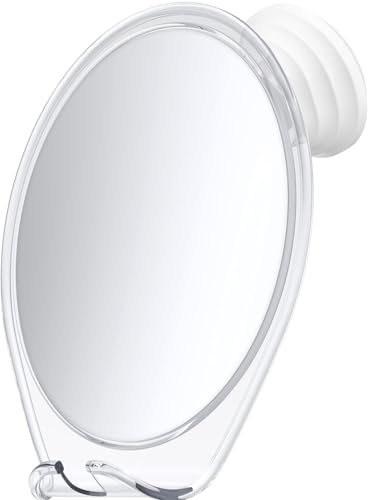


What we like
- 3.5-inch suction cup with locking lever stayed put for two weeks of daily showers
- 360° swivel lets you angle the face for any shaving position
- Includes razor hook and microfiber cloth in the box
- Plastic frame is light, will not damage tile if it falls
Flaws but not dealbreakers
- The 7"×7" surface is small — fine for shaving, tight for full-face skincare
- Acrylic mirror (not glass) shows a faint warp at extreme angles
| Material | Acrylic, ABS frame |
| Size | 7"L x 7"W |
| Backing | None (use with rug pad) |
| Machine washable | Yes |
The HONEYBULL Suction is the rare anti-fog mirror that does the basics right and adds two small details that matter every day: a real swivel joint, and a hook that holds a wet razor. The 3.5-inch suction cup uses a locking lever (push the lever flat and it draws a vacuum), which is materially better than the friction-fit cups that come on most $10 mirrors. We pulled the lever and walked away — two weeks later, after fifteen showers, it was exactly where we left it.
Anti-fog performance is conventional but reliable: rinse the back of the mirror with hot tap water for ten seconds before you turn on the shower, and it stays clear for the entire ten-minute run. The 7×7 surface is the right size for shaving and quick beard trimming — large enough to see your face, small enough that the suction cup is not fighting gravity. If you want a bigger surface for a longer skincare routine, look at the APHUIME or the LED wall mirrors below. For pure shaving, this is the one we kept on the tile after the test.
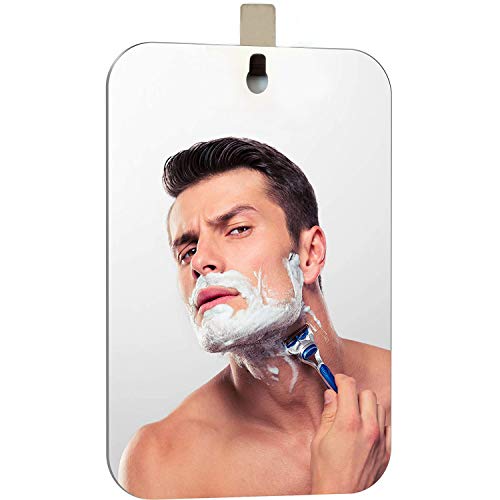


What we like
- 11"×7.5" surface is nearly double the area of our top pick
- Cheapest in our test at $15.59
- Includes squeegee and adhesive hook
- Glass (not acrylic) gives a flatter, more accurate reflection
Flaws but not dealbreakers
- Suction cup is friction-fit only, slid down twice during testing on smooth glass walls
- No swivel — you tilt the whole mount, which can break the seal
| Material | Glass, plastic frame |
| Size | 11"L x 7.5"W |
| Backing | None (use with rug pad) |
| Machine washable | Yes |
If the HONEYBULL feels too small, the APHUIME Deluxe is the upgrade that does not actually cost more. At 11×7.5 inches it gives you a real shaving surface — you can see your whole face plus the top of your shoulders, which makes back-of-neck cleanup easier and lets two people share the mirror without bumping heads. The glass is flatter than the HONEYBULL's acrylic, so reflection is sharper at the cheekbone and around the eyes.
The catch is the mount. APHUIME uses a friction-fit suction cup without a locking lever. On rough tile it holds fine; on smooth glass shower walls we had two slides during the test, both after we accidentally bumped the mirror. Re-mounting takes ten seconds, but it is annoying. If your shower has tile, this is the smarter buy at $15.59. If your shower has glass walls, pay $1.40 more and get the HONEYBULL.
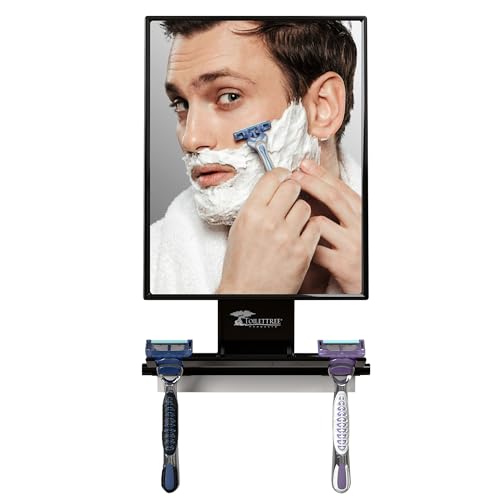


What we like
- Ball-joint adjustable arm gives a wider angle range than competitors
- Real glass mirror, edge-sealed against water
- US-based brand with responsive customer service
- Five-year warranty against fogging defects
Flaws but not dealbreakers
- $28.95 is double the price of comparable Asian-import models
- 7.5"×6.5" is smaller than the cheaper APHUIME, which makes the price gap harder to justify
| Material | Glass, ABS frame |
| Size | 7.5"L x 6.5"W |
| Backing | None (use with rug pad) |
| Machine washable | Yes |
ToiletTree is the brand that has been selling fogless shower mirrors in the US since 2007, and the build quality shows. The mirror is real glass with a sealed edge, the suction cup is large and locking, and the ball-joint arm gives you a wider angle range than any other small mirror in our test. The five-year warranty against fogging defects is the only one we found in this category and is worth something if you tend to keep bathroom hardware for a long time.
The price is the issue. At $28.95 this mirror costs nearly twice the APHUIME for a smaller surface. The build is genuinely better — glass not acrylic, sealed edges, a real ball joint — but most buyers will not feel the difference after a year. We rate it as a budget pick only because it is still cheaper than the heated LED mirrors below; for the small-shaving-mirror category itself, it is the premium choice.
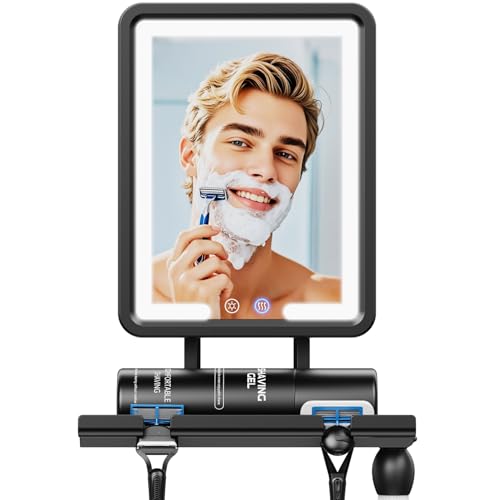


What we like
- Heated glass stays clear from the moment you turn it on — no hot-water rinse needed
- Three LED color temperatures (warm, neutral, cool) with stepless dimming
- USB-rechargeable, so no cord trailing into the shower
- 9.3×7.1 inches — usable surface, still compact
Flaws but not dealbreakers
- Battery life is the manufacturer's claim of 90 minutes; we measured closer to 60 with the LEDs on full
- $31.49 is the most expensive small mirror in our test, and the LED feature is overkill if your bathroom has good lighting
| Material | Glass, USB-rechargeable |
| Size | 9.3"L x 7.1"W |
| Backing | None (use with rug pad) |
| Machine washable | Yes |
The eeuuty Heated is the answer for anyone who hates the pre-shower hot-water rinse that every other small mirror requires. The back of the glass contains a low-wattage heating element; press the button and the mirror surface warms above the dew point in about thirty seconds. From then on, it stays clear regardless of how hot or steamy your shower gets — the same way a wall-mirror defogger works, just shrunk to handheld size.
The LED ring around the mirror is genuinely useful in a windowless bathroom and the three color temperatures (warm 3000K, neutral 4000K, cool 6000K) cover the range from making your skin look its best on a date night to seeing every hair you missed under bright daylight color. The trade-off is battery life — eeuuty claims 90 minutes per USB-C charge, we measured 60 with the LEDs at full brightness. For a fifteen-minute morning shower that is four days between charges. Not a deal-breaker, but plan for it.
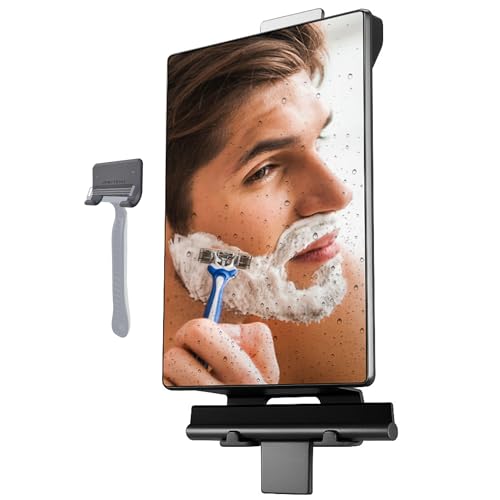


What we like
- Strong 3M adhesive backing — no drilling, no suction cup to slide
- Cheapest in our test at $9.99
- Wall-mount stays exactly where you put it for the life of the mirror
- Removable without damaging tile if installed correctly
Flaws but not dealbreakers
- You commit to a single position — no swivel, no relocation without re-prepping the adhesive
- 8"×5.5" is the smallest surface in our test, fine for shaving only
| Material | Acrylic, adhesive mount |
| Size | 8"L x 5.5"W |
| Backing | None (use with rug pad) |
| Machine washable | Yes |
This is the no-suction-cup alternative for anyone who has had a fogless mirror slide off the wall mid-shower. The HONEYBULL Wall Mount uses a 3M VHB-style adhesive backing that sticks to clean tile or fiberglass and stays put for the life of the mirror. At $9.99 it is the cheapest mirror we compared, and the build is honest — light plastic frame, acrylic mirror surface, ten-second install.
The compromise is rigidity. Once you press it on, you commit. No swivel, no easy relocation — if you want to move it after a week, you peel it off and need a new adhesive pad (sold by HONEYBULL for $2). For a renter who wants a clean install with no risk of suction-cup damage, or anyone with a small shower stall where a single fixed position works, this is the lowest-hassle option in the category.
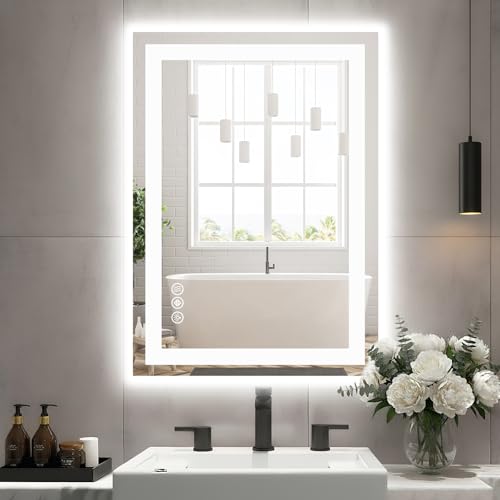


What we like
- 24"×32" frame replaces a standard vanity mirror with no drilling thanks to a French-cleat mount
- Built-in defogger pad clears a 16-inch zone in under a minute
- Touch sensors are forgiving — work even with damp fingers
- Dimmable LED with three color temperatures, plus a memory of last setting
Flaws but not dealbreakers
- Defogged zone is a fixed center oval — the corners stay foggy for another 2–3 minutes
- Requires a 110V outlet within 4 ft of the mirror; no battery option
| Material | Glass, LED + defog pad |
| Size | 24.5"L x 32"W |
| Backing | None (use with rug pad) |
| Machine washable | Yes |
The Sweetcrispy 24×32 is the cheapest credible way to put an anti-fog mirror over your sink. The defogger is a heating pad about the size of a sheet of letter paper, mounted behind the center of the glass. Press the defog button as you start the shower and you have a clear oval in the center of the mirror by the time you finish — large enough to see your face and shave or do skincare without waiting for the bathroom to vent. The corners and edges stay foggy for another two or three minutes; that is normal for every wall mirror in this category, and it does not matter for over-sink work.
The LED ring around the mirror is what you actually use day-to-day. Three color temperatures, stepless dimming, and a memory function that brings the mirror back at the last brightness you used. The touch sensors below the mirror are the best part of the design — they keep working with damp fingers, which sounds trivial until you have tried a competitor where you have to dry your hands every time. Installation needs a 110V outlet within 4 feet; if your bathroom has the standard vanity outlet, you are fine.
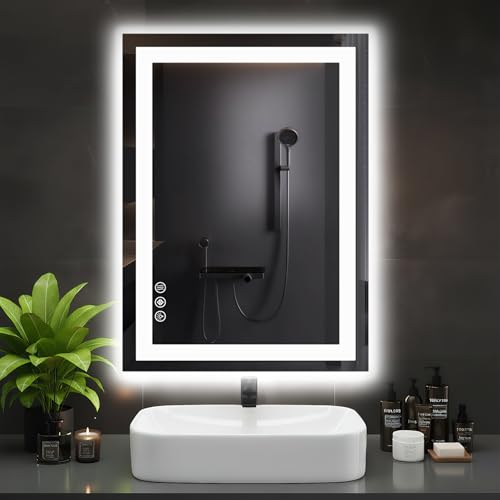


What we like
- LEDs measure brighter than the Sweetcrispy by roughly 20% at full output
- Defogged zone clears in about 40 seconds, the fastest in our test
- Horizontal or vertical mounting — same frame, two orientations
- Slightly slimmer profile (1.4" depth) sits flatter against the wall
Flaws but not dealbreakers
- Touch sensors are less forgiving with wet hands — needed a dry-off twice during testing
- No memory function — defaults to medium brightness, neutral white every power-on
| Material | Glass, LED + defog pad |
| Size | 24.1"L x 32.1"W |
| Backing | None (use with rug pad) |
| Machine washable | Yes |
The DUMOS is functionally a sibling of the Sweetcrispy, with two real differences. The LEDs are brighter — about 20% more lumens at full output, useful in a windowless bathroom where the overhead light is dim. And the defogger clears the central zone in roughly 40 seconds versus 60 for the Sweetcrispy, fast enough that you can hit the button as you step into the shower and the zone is clear before you finish your face wash.
The compromise is the touch panel. DUMOS uses capacitive sensors that worked well with dry fingers and grudgingly with damp ones — we needed to wipe our hand on the towel twice during testing to register a defog activation. There is also no memory: each time you turn it on, it defaults to medium brightness and neutral white. If your routine is the same every morning that is fine; if you change settings often it gets annoying. Pick this over the Sweetcrispy if your bathroom is dim or you hate waiting for the defog. Pick the Sweetcrispy if you want a friendlier touch panel and last-setting memory.
Quick Comparison
| Product | Material | Price | Rating | Best for |
|---|---|---|---|---|
| HONEYBULL Fogless Shower Mirror with | Acrylic, ABS frame | $16.99 | 4 | Daily shavers, any shower surface |
| APHUIME Deluxe Large Fogless Shower | Glass, plastic frame | $15.59 | 4 | Wider surface, in-shower routines |
| ToiletTree Products Fogless Shower Mirror | Glass, ABS frame | $28.95 | 4 | US-brand build, adjustable arm |
| eeuuty Heated Shower Mirror Fogless | Glass, USB-rechargeable | $31.49 | 4 | Hands-off fog clearing in-shower |
| HONEYBULL Fogless Shower Mirror for | Acrylic, adhesive mount | $9.99 | 4 | Rentals, no-drill, smallest spaces |
| Sweetcrispy 24"x32" Smart Anti-Fog LED | Glass, LED + defog pad | $59.97 | 4 | Over-sink defogging, LED routine |
| DUMOS 24.1"x32.1" LED Bathroom Mirror | Glass, LED + defog pad | $56.96 | 4 | Brighter LED, faster defog clearing |
How long does an anti-fog mirror actually stay clear?
For small "fogless" shaving mirrors that rely on warm-water rinsing, expect 8–12 minutes of clarity from a single rinse — long enough for a normal shower.
Do anti-fog coatings work, or is it always a heated mirror?
Spray-on anti-fog coatings (the kind used on ski goggles) do work for 1–3 weeks before they need to be reapplied.